
Climbing plants are a fantastic, affordable way to transform an ordinary fence into a beautiful garden feature.
These plants can be used to soften the appearance of boundaries, bring a more natural aesthetic to your outdoor spaces, and add more privacy.
Below, our team of fencing experts have shared their guide to choosing the right plants and the right fence for climbing plants. They’ve also shared some creative tips for adding climbing plants to your outdoor space, to achieve the most stunning results all year round.
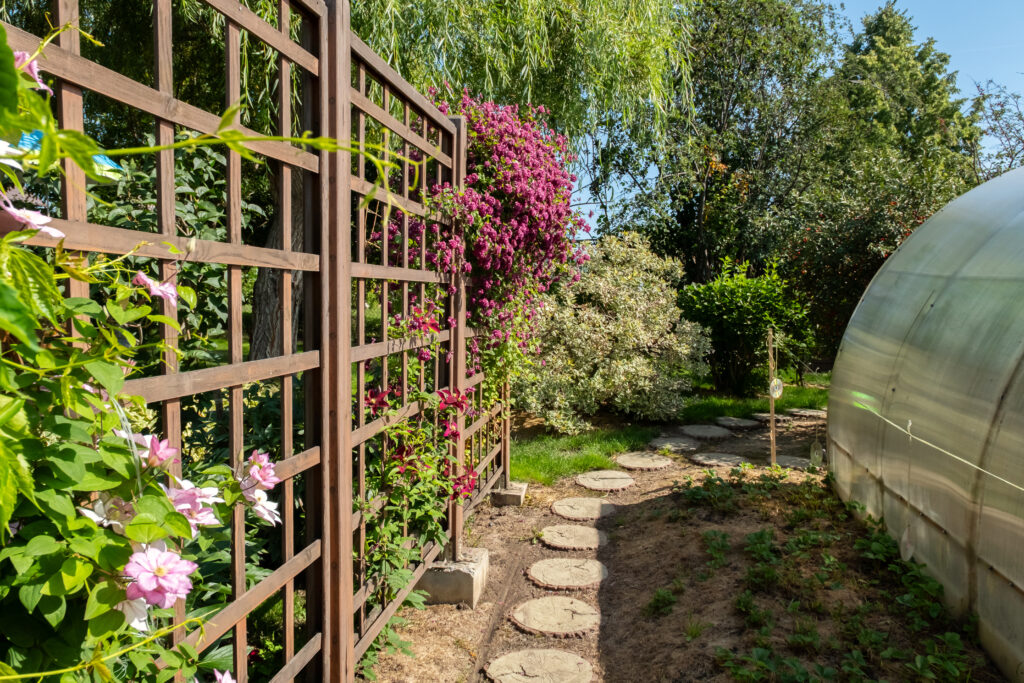
Choosing the right climbing plants
You may think that most plants could achieve the desired effect, and be set up as a climbing plant.
But in reality, different types of climbing plants use different methods to attach themselves to supports.
Some plants have twisting stems, others have tendrils, and some need to be manually tied to the fixing points as they grow.
So, you will need to choose the right type of climbing plant for your fence type, and for the conditions present in your garden. This will not only ensure they thrive, but also that they look their best, with minimal maintenance requirements.
The most popular climbing plants, and their specific requirements, include:
- Clematis – Popular due to its bright colour and texture. Clematis plants twine around supports. As a result, they are ideally suited to trellis panels and lattice fencing. They grow best in sunny spots, when their roots are shaded.
- Climbing roses – Renowned for their beautiful blooms and scent. Climbing roses have woody stems, which mean they require a sturdy fence or trellis to support them. They can be a higher maintenance plant, as they often require training and tying in.
- Honeysuckle – A great fast-growing plant, which is highly fragrant and attracts bees and butterflies. Honeysuckle is ideally suited to traditional trellis fencing.
- Ivy – A great hardy plant, and as an evergreen plant, it remains green all year round. Ivy can climb solid surfaces, or be used with lattice fencing.
- Wisteria – A beautiful statement climbing plant, with large hanging flowers. It requires a strong, reinforced trellis or a timber framework.
The best types of fencing for climbing plants
Now, let’s explore the different types of fencing options.
- Trellis fencing – Ideally suited to lightweight climbers, such as clematis or honeysuckle. Panels can either be fixed to existing fences, or positioned as standalone screens.
- Lattice-top fencing – Features a solid base panel and an open lattice top. This ensures full privacy at ground level, while allowing plants to spread at the top.
- Heavy-duty trellis – As the panels are reinforced, these are a great choice for tougher or heavier climbing plants, such as wisteria or roses.
- Wall-mounted trellis sections – A great space-saving solution, which can be neatly added to garden walls or outbuildings.
All trellis and lattice fencing can be pressure-treated, to ensure long-lasting protection against degradation, particularly moisture and decay.
Generally speaking, a trellis (or lattice) style of fence is ideal for climbing plants. This is because the gaps in the fence are perfect for allowing plants to latch on and grow. But, you should base your decision on the weight of your plant, and any other specific requirements that your chosen plant(s) have.
Climbing plants garden inspiration
With climbing plants, there’s scope for a wide range of creative possibilities.
Some of our favourite ideas include:
- Living feature walls – By covering a wall with wall-mounted trellis sections, you can create a living feature wall. By choosing a mixture of different plant species, you can ensure the wall is in colour all year.
- Natural dividers – Trellis panels can be used to create natural dividers in the garden, achieving different zones or sections in a completely unobtrusive way. For example, you could use this approach to create elegant seating areas.
- Privacy screens – By adding fast-growing plants like ivy or jasmine to boundary fences, you can quickly increase the privacy of your garden, without having to resort to physical barriers.
- Layering greenery – By blending climbing plants and wall planters with a variety of plant species, you can create a striking layered effect, which maximises the amount of greenery in a smaller area.
At Barnard Fencing, we supply a wide range of trellis and decorative fencing panels, with options available to suit all types of climbing plants and all gardens.
If you’re interested in adding climbing plants to your garden, our talented team are on hand to advise you, and help you choose the best solution that ticks all your boxes.
To find out more, don’t check out our range of fencing panels and trellis options, or get in touch with our team.


